
** Read below for the lesson from the book **
Assignment:
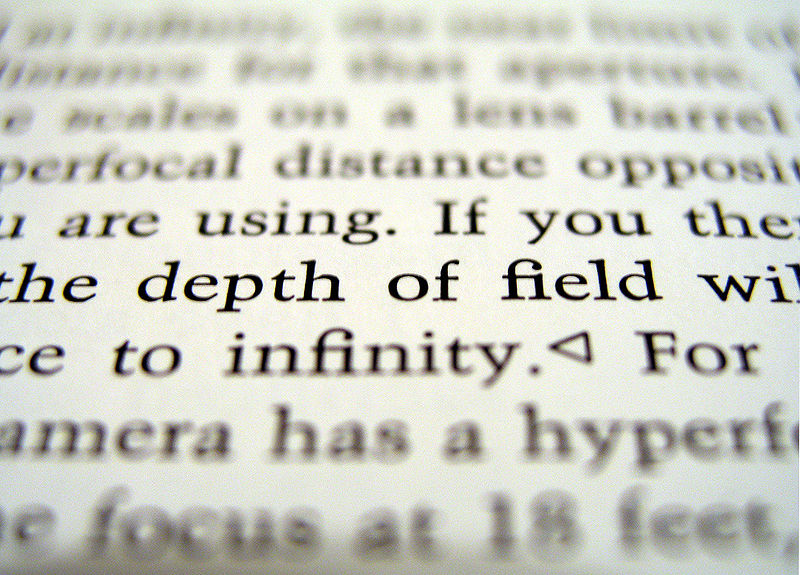
Use your camera to create a photograph (or two) with a focal point that is not in the center of the photograph -- make sure that you place the plane of critical focus on your subject, and try to visualize and demonstrate with your photograph the depth of field concept.
I'm going to try and do a lesson a week now, so the assignment is due Friday, May 9th. I will post the images on Saturday, and put the next lesson up on Sunday.
Can't wait to see your pictures! :)
Excerpt from "A Short Course on Photography:"
Focus and Depth of Field
Sharp focus attracts the eye. Sharp focus acts as as signal to pay attention to a particular part of a photograph, especially if other parts of the image are not as sharp. If part of the a picture is sharp and a part is out of focus, it is natural to look first at the sharply focused area. When you are photographing, it is also natural to focus the camera sharply on the most important area. You can select and, to a certain extent, control which parts of a scene will be sharp.
When you focus a camera on an object, the distance between lens and film (or digital image sensor) is adjusted, usually by rotating the lens barrel until the object appears sharp on the viewing screen. You focus manually by turning the focusing ring on the lens barrel. If you are using an automatic-focus camera, you focus by partially depressing the shutter-release button.
Depth of field . In theory, a lens can only focus on one single distance at a time (the plane of critical focus [the first few paragraphs and image on this page help clarify what the plane of critical focus is]) and objects at all other distances will be less sharp. But, in most cases, part of the scene will be acceptably sharp both in front of and behind the most sharply focused plane. Objects will gradually become more and more out of focus the farther they are from the most sharply focused area. This region within which objects appear acceptably sharp in the image -- the depth of field -- can be increased or decreased.
Depth of field is the part of a scene that appears acceptably sharp in a photograph.
Imagine the place of critical focus (the distance on which you focus the lens) to be something like a pane of glass stretched from one side of the scene to the other. Objects that lie along that place will be sharp. In front of and behind the plane of critical focus lines the depth of field, the area that will appear acceptably sharp. The farther that objects are from the place of critical focus in a particular photograph, either toward the camera or away from it, the less sharp they will be. If objects are far enough from the place of critical focus to be outside the depth of field, they will appear noticeably out of focus.
Automatic Focus
Automatic focus used to be found only on point-and-shoot snapshot cameras. But now it is standard equipment on almost all 35mm and digital cameras. When you push down the shutter-release button part way, the camera adjusts the lens to focus sharply on what it thinks is your subject -- usually whatever object is at the center of the viewing screen.
Sometimes you will want to focus the camera manually. Just as with automatic exposure, there will be times when you will want to override the automatic mechanism and focus the camera yourself. Most 35mm single-lens reflex cameras with automatic focus will also let you focus manually [most digital cameras will let you manually focus as well].
The most common problem occurs when your subject is at the side of the frame, not at the center. A camera may also have problems focusing if a subject has very low contrast, is in very dim light, or consists of a repetitive pattern.
Moving subjects can also cause problems. The adjustment of the autofocus mechanism can sometimes take long enough for a fast-moving subject, such as a race car, to move out of range. The lens maybe "hunt" back and forth, unable to focus at all or maybe making an exposure with the subject out of focus.
Some cameras have more sophisticated electronics to deal with tehse problems better. Read the instructions for your camera so you know how its autofocus mechanism operates.
Take a moment to evaluate each situation. Override the automatic system when it is better to do so, rather than assume that the right part of the picture will be sharp simply because you are set to automatic focus.
Automatic focus can mean out of focus when a scene has a main subject (or subjects) off to one side and at a different distance from whatever object is at the center. Most autofocus cameras will focus on the object at the center of the frame, [usually within a small bracketed area].
To correct this, first choose the focusing distance by placing the autofocus brackets on the main subject and partially pressing down the shutter-release button. Lock the focus by keeping the partial pressure on the shutter-release. Re-frame your picture while keeping the partial pressure on the shutter-release. Push the shutter button all the way down to make the exposure.
--A Short Course in Photography: An Introduction to Photographic Technique


7 comments:
Sound like fun! I can't wait to see what everyone comes up with!
I just thought I should mention that Chad took the time and effort to put this post up--thanks honey! can't wait to get started!
I'm in!
Hooray! I have been excited for the next one.
Woo Hoo for assignment #2!
i think i may have a good one i just took for this!
what is your email address? i want to try it out! mine is emlow07@gmail.com
Post a Comment